
SPCX Slips Below Its IPO Price as 911M Shares Unlock

 Prefer us on Google


SPCX is trading below the $135 price at which SpaceX sold shares in June — the first time the largest IPO on record has been underwater for the people who bought it at the offer. That happened in the same week the company beat revenue estimates by nearly $1 billion and released roughly 911.5 million insider shares from lockup. Both facts are true, and the second one is why the first one matters more than it looks.
As of August 7, 2026, SPCX changed hands at about $110.90, up 2.4% on the day but 17.9% below the IPO price and roughly 51% below the $225.64 peak it set in June. The 52-week low, $104.83, was set this month.
Where SPCX trades now versus its $135 IPO price
The round trip is worth laying out precisely, because "SpaceX stock crashed" and "SpaceX stock gave back an unsustainable IPO pop" describe the same chart and imply very different things.
| Milestone | Date | Price | Change vs. $110.90 |
|---|---|---|---|
| IPO offer price | Jun 12, 2026 | $135.00 | −17.9% |
| First-day open | Jun 12, 2026 | $150.00 | −26.1% |
| First-day close | Jun 12, 2026 | $160.95 | −31.1% |
| All-time high | Jun 2026 | $225.64 | −50.9% |
| 52-week low | Aug 2026 | $104.83 | +5.8% |
| Last price | Aug 7, 2026 | $110.90 | — |
Prices as of August 7, 2026. Source: Nasdaq and exchange quote data.
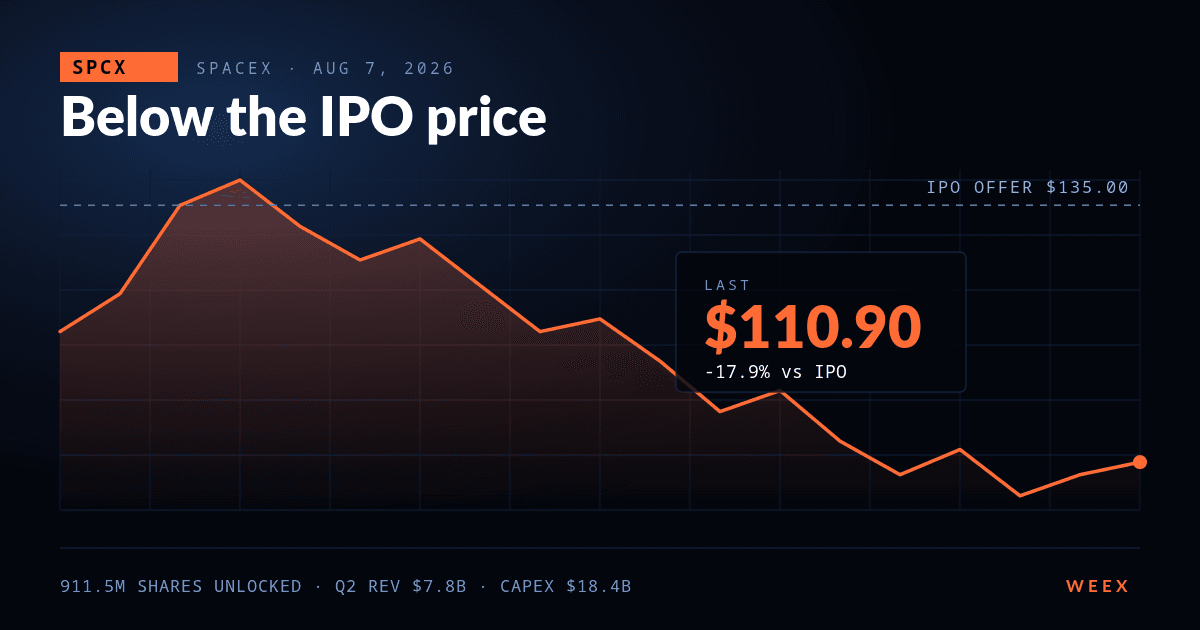
Two months is a short window to lose half your peak value, but the peak itself was built on a float of about 555.6 million Class A shares against enormous demand. Scarcity was doing a lot of the pricing work. The August 6 unlock is the event that removed it.
Why is SPCX falling after strong Q2 earnings?
SpaceX reported its first quarter as a public company on August 4, and the top line was not the problem.
| Q2 2026 metric | Reported | Consensus / prior year |
|---|---|---|
| Revenue | $7.8B | $6.8B expected (FactSet); +92% YoY |
| Connectivity (Starlink) revenue | $4.3B | $3.83B expected; +66% YoY |
| Starlink subscribers | 12 million | 2x YoY, +17% QoQ |
| Adjusted EBITDA | $3.5B | +191% YoY |
| Net loss | $541M | $1.0B loss a year earlier |
| Capital expenditure | $18.4B | $10.1B prior quarter |
Reported August 4, 2026. Source: SpaceX Q2 2026 results and contemporaneous coverage.
The stock fell as much as 8% after hours anyway, and the line that caused it is the last one. Capex of $18.4 billion in a quarter is more than double the prior quarter and more than twice the quarter's revenue. Starship cadence, Starlink constellation replacement, and the compute buildout behind the Google and Anthropic deals all have to be paid for before they earn anything. A company still posting a net loss while spending at that rate is asking shareholders to fund the gap, and the market's job is to price how long that lasts.
The better reading of the sell-off is not that the business disappointed. It is that a stock priced for near-perfect execution got a quarter that was excellent on growth and expensive on cash — and that is enough to break a valuation with no margin for error.
What the August 6 lockup expiry actually released
This is the part most SPCX coverage compresses into a single sentence, and it deserves more.
Roughly 911.5 million insider shares became eligible to trade on August 6 — worth somewhere between $100 billion and $123 billion depending on which price you mark them at. That is a larger dollar figure than most companies' entire market capitalization.
But eligible is not the same as sellable, and sellable is not the same as sold:
- Insiders may sell up to the first 20% of eligible shares at this stage, not the whole block.
- A further 455.8 million shares can unlock later under specified conditions.
- Elon Musk and a defined group of insiders stay locked until mid-2027.
- An accelerator clause would have released an extra 10% early if SPCX had traded at least 30% above the IPO price on five of ten consecutive sessions before earnings. It did not, so that tranche did not trigger.
That last point is the one worth holding onto. The lockup structure was written to reward strength, and the stock failed the test. The unlock arrived on the schedule for a stock that had not performed, not the schedule for one that had.
The immediate price reaction was muted — shares were roughly flat on August 6 and up on August 7 — which usually means the supply was already discounted into the June and July decline. What has changed is durable rather than dramatic: the float is now structurally larger, and every future rally has more potential sellers standing above it. Overhang is a slow tax on price, not a single-day crash.
SPCX stock versus tokenized SPCX: what you actually own
Because SpaceX is now a listed company, several different instruments carry the SPCX name and they are not interchangeable. This distinction matters more here than for most tickers, because the crypto-side products existed before the equity did.
| Instrument | What it is | Rights | Hours | Leverage |
|---|---|---|---|---|
| SPCX on Nasdaq | Class A common stock | Ownership, voting per class terms | US market hours | Broker margin |
| SPCXX/USDT on WEEX | xStocks tokenized certificate on Solana, backed 1:1 by shares in regulated custody | Price exposure only; no vote, no shareholder rights | 24/7 | None (spot) |
| SPCX-USDT on WEEX | USDT-margined perpetual future | None; cash-settled contract | 24/7 | Up to 20x |
WEEX product details as of August 7, 2026. SPCXX/USDT listed for trading June 12, 2026, 15:00 UTC.
A tokenized certificate tracks the share price and is collateralized against real custodied shares, but you are a token holder, not a shareholder. A perpetual does not even do that — it is a contract referencing the price, with funding paid or received for as long as you hold it. Neither pays a dividend, neither votes, and neither gives you a claim on SpaceX.
Traders confuse these constantly, and the confusion is expensive in exactly one direction: people size a 20x perpetual as though it were a share purchase, then get liquidated on a move that a shareholder would have simply sat through.
How to trade SPCX on WEEX after the unlock
If you want crypto-native exposure rather than a brokerage account, WEEX runs both sides of it.
For spot exposure, SPCXX/USDT is the tokenized SpaceX xStock, live since the IPO date. The listing announcement sets out the mechanics: a Solana SPL tracking certificate, backed 1:1 by shares held in regulated custody, with no shareholder rights attached.
For directional or hedged exposure, SPCX-USDT perpetual futures offer up to 20x leverage and trade around the clock, including the hours when Nasdaq is closed. If perpetual mechanics are new to you, WEEX's guide to how these contracts price, fund, and resolve covers index versus mark price, funding intervals, and what happens at corporate events.
Three practical points specific to this moment:
Weekend gap risk is real and asymmetric. The perpetual trades 24/7; the underlying does not. If material news breaks while Nasdaq is shut, the perpetual repriced it and you were either positioned or liquidated before the equity market had a say.
Size for the overhang, not the headline. With a structurally larger float, upside moves are more likely to meet supply. A position sized for a clean breakout is sized wrong for a market that has 911.5 million newly eligible shares looking for exits.
Funding is a running cost. Holding a leveraged directional view across weeks means paying funding repeatedly, whether or not the view eventually proves correct.
Is SPCX a buy below its IPO price?
Below the offer price is a psychological level, not a valuation. It tells you what a syndicate of banks and a company agreed on in June, not what the business is worth in August.
The honest framing is that the bull and bear cases now rest on the same number. Revenue nearly doubled year over year and Starlink is compounding subscribers at a rate few infrastructure businesses ever achieve. That is real. But $18.4 billion of quarterly capex against a $541 million net loss means the equity is still funding the buildout, and the market is repricing how many years of that it will tolerate.
What matters most for the next quarter is not the next Starship flight. It is whether capex guidance moderates and whether the remaining lockup tranches meet a rising stock or a drifting one. Those two variables will do more to the SPCX price than any launch.
For a fuller account of how the post-IPO decline developed, see WEEX's earlier breakdown of why SPCX fell from its June peak.
FAQ
1. Why is SPCX below its IPO price?
SPCX traded at about $110.90 on August 7, 2026, against a $135 IPO price. The decline reflects the unwind of a scarcity-driven June rally, a valuation that left no room for error, and an August 4 earnings report where record revenue came alongside $18.4 billion in quarterly capital expenditure.
2. How many SPCX shares unlocked on August 6, 2026?
Roughly 911.5 million insider shares became eligible, valued at approximately $100–123 billion depending on the reference price. Insiders may sell up to the first 20% at this stage. A further 455.8 million shares can unlock under specified conditions, and shares held by Elon Musk and select insiders remain locked until mid-2027.
3. Did SpaceX beat earnings expectations in Q2 2026?
Yes. Revenue came in at $7.8 billion versus a FactSet consensus of $6.8 billion, up 92% year over year. Starlink-led connectivity revenue reached $4.3 billion against $3.83 billion expected. The stock still fell after hours on capital expenditure of $18.4 billion.
4. Is SPCXX on WEEX the same as owning SpaceX stock?
No. SPCXX is an xStocks tokenized tracking certificate issued on Solana and backed 1:1 by shares held in regulated custody. It gives price exposure only — no voting rights, no dividends, and no shareholder claim on SpaceX.
5. Can I short SPCX without a brokerage account?
SPCX-USDT perpetual futures on WEEX allow long or short positions with up to 20x leverage, settled in USDT and trading 24/7. This is a derivative contract, not a share, and carries funding costs and liquidation risk that equity ownership does not.
6. What is the next catalyst for the SPCX price?
The remaining lockup tranches and the trajectory of capital expenditure guidance. Both determine share supply and cash burn, which are currently the two variables the market is most sensitive to.
Risk Warning
SPCX and its tokenized and derivative equivalents are volatile instruments and may result in partial or total loss of capital. The stock has moved from $135 to $225.64 to $104.83 within roughly two months, and further lockup tranches represent ongoing supply overhang that can cap rallies. SPCXX is a tokenized certificate, not equity — it carries issuer, custodian, and smart-contract risk in addition to price risk, and confers no shareholder rights, dividends, or voting power. SPCX-USDT perpetual futures carry leverage and liquidation risk: at 20x, a small adverse move can wipe out margin, and because the contract trades when Nasdaq is closed, positions can be liquidated on weekend or overnight moves with no ability to hedge in the underlying. Funding payments accrue for as long as a position is held. Availability of these products varies by region and is subject to local law and eligibility requirements. Nothing here is investment advice; assess your own risk tolerance and position size before trading.
This content is provided for general informational purposes only and doesn't constitute financial, investment, legal, or tax advice. Any events, rewards, online promotions, or related information mentioned herein should not be considered a recommendation, solicitation, or invitation to purchase, sell, trade, or otherwise deal in any crypto assets. Crypto assets are highly volatile and may result in loss. The availability of WEEX services, products, and related events may vary by region. You are responsible for ensuring that your participation is in accordance with applicable local laws and regulations.
You may also like

KGHM Stock Forum: Copper, Silver, and the Argument the Thread Keeps Getting Backwards
Gold Forum: Where the Polish Discussion Actually Happens — and the Question It Argues About Most
JSW Stock Forum: What the Threads Are Actually Arguing About — and What They Cannot Tell You
What Is Polymarket and How Does It Work?

What Is Phantom Wallet? How to Install the Official Version Safely and Use It

What Is the Crypto Fear and Greed Index? Components, Scale and Limits
What Is Robinhood Chain? How to Add the Network to MetaMask Safely
Is Zero Knowledge Technology Actually Ready for Everyday Use?
zk-SNARK vs zk-STARK: What's the Difference?
How Zero Knowledge Proofs Are Used in Blockchain Today
What Is Zero Knowledge Proof? A Beginner's Guide
Is PGP Still Secure in 2026?

PGP vs End-to-End Encryption: What's the Difference?
Roblox Stock Price Prediction 2026-2027: Can RBLX Recover After Pulling Full-Year Guidance?
Is RBLX Stock a Buy After Falling 74% From Its All-Time High?
Roblox Stock Falls 29% on Its Worst Day Ever: What the Bookings Miss and Pulled Guidance Actually Mean
Marvell Stock Jumps 13% on AI Memory Infrastructure Upgrades: What the New Portfolio Actually Changes

Opendoor Stock Price Prediction 2026-2027: Can OPEN Reach the $4.95 Analyst Target After the Q2 Turnaround?

Opendoor Stock Q2 2026: What Everything Is Up and Costs Are Down Actually Means for OPEN
Apple Stock and the China $280 Downgrade: What a Chinese Firm Cutting Apple to Hold Actually Signals
STONKBROKER Token: What You Actually Own Without a StonkBrokers NFT
Apple Stock Is Adding Android Phones to Trade-In: What the Strategy Shift Actually Means for iPhone Growth
Apple Stock and the OpenAI Lawsuit: What OpenAI Calling Apple's Case Careless and Aggressive Actually Means for AAPL
XST Coin and the Solana AI Narrative: Why Low-Cap AI Tokens Are Outperforming in August 2026
Should You Buy XST Coin at $0.020? What Changed Since the $0.007 Entry
XST Coin Is Up 188% in One Week: What Is Actually Driving the XSolut Rally
MU Stock at $892: Why Micron Fell 29% From Its Peak
SanDisk Earnings: Why $93.9B in Contracts Capped the Guide
ABNB Stock Jumps 11% on Q2 Beat: What the Earnings Gap Means for Traders
Meta Stock Near $590: What the Cash Flow Collapse Means
KGHM Stock Forum: Copper, Silver, and the Argument the Thread Keeps Getting Backwards
Gold Forum: Where the Polish Discussion Actually Happens — and the Question It Argues About Most
JSW Stock Forum: What the Threads Are Actually Arguing About — and What They Cannot Tell You
What Is Polymarket and How Does It Work?
What Is Phantom Wallet? How to Install the Official Version Safely and Use It
What Is the Crypto Fear and Greed Index? Components, Scale and Limits
Contents
Popular coins
Latest articles




