
Meta Stock Near $590: What the Cash Flow Collapse Means

 Prefer us on Google

Meta stock closed at $589.90 on August 6, 2026 — about 26% below the $796.25 record it set in August 2025, and only $70 above its 52-week low. The odd part is that the business is not shrinking. Revenue grew 28% last quarter. What broke was cash.
That distinction is the whole story behind Meta stock right now, and most quote pages will show you the chart without explaining it. Below: what the Q2 2026 numbers actually said, why Wall Street's targets still sit roughly 30% above the market price, and how traders are taking positions on META outside NASDAQ hours using USDT.
Meta Stock Price Today and the 26% Drawdown
| Metric | Value | As of |
|---|---|---|
| NASDAQ close (META) | $589.90 | Aug 6, 2026 |
| WEEX META-USDT perpetual, last price | 590.64 | Aug 7, 2026 |
| All-time high | $796.25 | Aug 15, 2025 |
| 52-week range | $520.26 – $796.25 | Aug 2026 |
| Drawdown from record | ~26% | Aug 6, 2026 |
| Market cap | ~$1.50T | Aug 2026 |
| Dividend yield | ~0.36% | Aug 2026 |
The perpetual price on WEEX tracked the NASDAQ close within about a dollar — worth noting, because the two instruments can and do separate when US equity markets are shut. More on that below.
Why Meta Stock Fell After Q2 2026 Earnings
Meta reported Q2 on July 29, 2026. Shares dropped roughly 6% after hours and kept sliding. The report was not a miss in the usual sense — the top line beat. It was a miss on everything downstream of the top line.
| What Meta reported (Q2 2026) | Result | Read |
|---|---|---|
| Revenue | $60.8B, +28% YoY | Beat consensus (~$60.2B) |
| Advertising revenue | +27% YoY | Core engine intact |
| Family of Apps Other revenue | +73% YoY | Fastest-growing line |
| Diluted EPS | $6.18, −13% YoY | Missed ~$7.22 consensus by ~15% |
| Net income | $15.8B, −14% YoY | Hit by $2.4B legal charge, $1.18B severance |
| Capital expenditure | $31.1B in the quarter | FY2026 guidance raised to $130–145B |
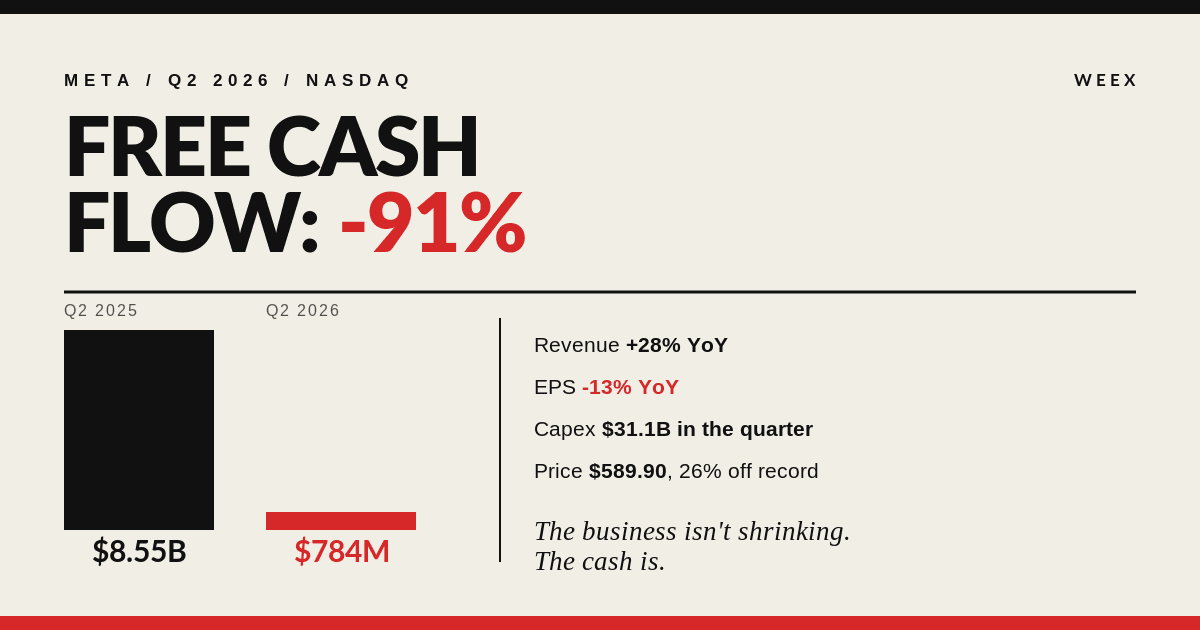
| Free cash flow | $784M | Down from $8.55B a year earlier |
| Q3 revenue guidance | ~$62.5B midpoint | Below the ~$63.2B analysts wanted |
Two of those lines pointed the same direction: the AI buildout is consuming cash faster than it is producing earnings growth. Markets forgive one of those. They rarely forgive both in the same release.
Free Cash Flow, Not Revenue, Is Repricing Meta Stock
A 91% collapse in free cash flow is the number that actually moved Meta stock, and it is worth being precise about why.
Capex hits the cash flow statement the moment the servers are bought. The revenue those servers are meant to generate arrives over years. For most of the last decade, Meta was a cash machine that returned capital while growing — that profile is what earned it a mega-cap multiple. In Q2 2026, Meta generated $784 million in free cash flow and paid roughly $1.35 billion in dividends and dividend equivalents. The gap was covered with new long-term debt.
That is a different company than the one investors bought in 2024. Not a worse one, necessarily — but one being valued on a different framework. Full-year capex guidance of $130–145 billion, against $72.2 billion spent in 2025, means this is not a one-quarter distortion. Meta has told the market to expect the cash drain to continue.
The more useful way to hold it: Meta stock is no longer trading on ad growth. It is trading on whether the AI capex earns a return before the balance sheet strain forces a change of plan.
Why Analyst Targets Still Sit 30% Above Meta Stock
Here is the tension that makes META interesting rather than simply weak.
| View | Level | Source basis |
|---|---|---|
| Market price | ~$590 | NASDAQ, Aug 6, 2026 |
| Consensus average target | ~$757 | 62 analysts, S&P Global, early Aug 2026 |
| Median target (broader survey) | ~$825 | 66 Wall Street analysts, Aug 2026 |
| High target | $1,117 | Most bullish coverage |
| Low target | $700 | Most bearish target still above spot |
| BofA Securities | $900 | Buy rating reiterated |
Note what that low target implies: even the most conservative analyst in the survey has META worth more than it trades for today. Consensus rating sits at Buy or Strong Buy, with roughly half the coverage at Strong Buy as of August 3, 2026.
Sell-side models discount 2028 and 2029 earnings, when the capex is assumed to have converted into monetizable AI products. The market is discounting the cash flow statement it can see now. Both can be internally consistent and still disagree by 30%. What resolves the gap is evidence — a quarter where capex growth flattens, or where AI-driven ad pricing lifts revenue faster than infrastructure costs climb.
Until then, the spread is not a mispricing to be arbitraged. It is a disagreement about timing, and disagreements about timing tend to express themselves as volatility.
Is Meta Stock a Good Buy at These Levels?
That depends entirely on which risk you are being paid to take, and it is worth being honest that nobody knows the answer.
The bull case is straightforward: a $1.5 trillion company growing revenue 28% with an intact advertising monopoly, trading 26% off its high, with every covering analyst pointing higher. If the capex cycle peaks in 2027, free cash flow snaps back violently.
The bear case is equally clean: guidance has been raised twice this year, dividends now exceed free cash flow, and Zuckerberg has not committed to a spending ceiling. "Capex peaks next year" has been said about every capex cycle in history, usually a year early.
For traders rather than investors, the practical read is that the directional call matters less than position sizing around catalysts. Meta's next earnings report is the event that settles the argument in either direction, and implied volatility around it will not be cheap.
How to Trade Meta Stock With USDT, 24/7
The gap most crypto-native traders run into with META is structural: taking a view requires a brokerage account, a bank wire, and a market that is open eight hours a weekday. Tokenized stock derivatives remove all three constraints.
On WEEX TradFi, META is available as a USDT-margined perpetual rather than an equity share. The practical terms, as published on the platform in August 2026:
| Parameter | WEEX TradFi (META) |
|---|---|
| Instrument | META-USDT perpetual futures |
| Margin asset | USDT only |
| Account | No separate TradFi account; uses spot or futures USDT balance |
| Max leverage, tokenized stocks | Up to 100× |
| Fees | Zero fees on stocks, gold and oil, per the current TradFi promotion |
| Trading window | 24/7 |
| Funding | Published on the contract page with a live countdown |
The workflow is short: deposit USDT, open the TradFi market list, select META-USDT, choose direction, then set size, leverage and stops before submitting. What you hold is price exposure to Meta Platforms — not shares, not voting rights, and not the dividend behind that 0.36% yield. If you were searching for a Meta Platforms coin, there isn't one; the distinction between an official token and a USDT-settled derivative is covered in whether META stock has a token.
The Weekend Gap Most Meta Stock Traders Miss
This is the trap that catches equity traders moving into 24/7 stock perps, and it is worth spelling out because no brokerage disclosure prepares you for it.
NASDAQ closes Friday afternoon. The META perpetual does not. Over the weekend the contract keeps trading against a reference price that is frozen, on thinner books than weekday liquidity, and 100× leverage does not get thinner alongside it. A headline on a Saturday — a regulatory filing, an AI announcement, a competitor's leak — can push the perp several percent while there is no underlying market to arbitrage it back.
Then Monday's open arrives and the equity gaps to wherever the news actually priced it. Positions carried through the weekend at high leverage are the ones that get liquidated on that print, not on Friday's move.
Two practical adjustments: cut leverage before the Friday US close rather than after, and set stops with weekend spread width in mind, not weekday width. The traders who blow up on tokenized stocks rarely get the direction wrong. They size for a market that trades continuously and liquidity that does not.
What to Watch From Here
Meta stock at $590 is a bet on the timing of an AI payback, priced by a market that has stopped extending the benefit of the doubt. The revenue engine is not the question. The question is how many more quarters of $30 billion capex against sub-$1 billion free cash flow shareholders will fund before the multiple compresses further.
Three markers worth tracking: whether Q3 capex guidance moves again, whether free cash flow stabilizes above the dividend obligation, and whether Family of Apps Other revenue keeps compounding at 70%-plus. If all three break favorably, the analyst targets stop looking optimistic. If the first one moves higher again, $520 comes back into view.
For traders who want exposure to that outcome without a brokerage account, META-USDT perpetuals on WEEX TradFi let you take either side with USDT margin, at any hour — provided the position is sized for a 24/7 contract on an asset that trades five days a week.
FAQ
1. Why is Meta stock down in 2026?
Free cash flow fell 91% year over year to $784 million in Q2 2026 as capital expenditure hit $31.1 billion in the quarter, and full-year capex guidance was raised to $130–145 billion. Revenue grew 28%, but earnings missed consensus by roughly 15% and Q3 revenue guidance came in below expectations.
2. What is the analyst price target for Meta stock?
Surveys as of early August 2026 put the consensus average near $757 and the median near $825, with a high of $1,117 and a low of $700. Consensus rating is Buy or Strong Buy. Analyst targets are forecasts, not commitments, and have historically clustered above market prices during drawdowns.
3. Does Meta Platforms have an official crypto token?
No. Meta Platforms has never issued a cryptocurrency. Instruments labelled META on crypto exchanges are either unrelated tokens using the same ticker, or USDT-settled derivatives tracking the share price.
4. Can you trade Meta stock with USDT?
Yes, through tokenized stock derivatives. On WEEX TradFi, META-USDT is a USDT-margined perpetual that tracks Meta's share price, tradeable 24/7 without a brokerage account. It provides price exposure only — no shares, voting rights or dividends.
5. What happens to a META perpetual when NASDAQ is closed?
The contract keeps trading while the underlying does not. Prices can drift on weekend news with no equity market to correct them, then gap at Monday's open. Liquidity is typically thinner outside US hours, which widens spreads and increases slippage on stops.
6. Is Meta stock a good buy at $590?
Nobody can answer that with confidence. The bull case rests on 28% revenue growth and a capex cycle that peaks in 2027; the bear case rests on dividends now exceeding free cash flow and guidance that has been raised twice this year. Size any position for the possibility that the disagreement takes several more quarters to resolve.
Risk Warning
Trading Meta stock derivatives carries substantial risk and may result in partial or total loss of capital. Tokenized stock perpetuals give price exposure only — they do not confer share ownership, voting rights, or dividends, and are not regulated equity securities. Leverage of up to 100× means a move of roughly 1% against the position can liquidate it. Specific risks for META include earnings-driven volatility, weekend gap risk when NASDAQ is closed and no underlying market exists to price news, funding costs on positions held over time, thinner liquidity outside US trading hours, and counterparty risk on the venue holding your USDT margin. Regulatory treatment of tokenized equities varies by jurisdiction and can change. Nothing here is investment advice. Never trade with capital you cannot afford to lose.
This content is provided for general informational purposes only and doesn't constitute financial, investment, legal, or tax advice. Any events, rewards, online promotions, or related information mentioned herein should not be considered a recommendation, solicitation, or invitation to purchase, sell, trade, or otherwise deal in any crypto assets. Crypto assets are highly volatile and may result in loss. The availability of WEEX services, products, and related events may vary by region. You are responsible for ensuring that your participation is in accordance with applicable local laws and regulations.
You may also like

KGHM Stock Forum: Copper, Silver, and the Argument the Thread Keeps Getting Backwards
Gold Forum: Where the Polish Discussion Actually Happens — and the Question It Argues About Most

JSW Stock Forum: What the Threads Are Actually Arguing About — and What They Cannot Tell You

What Is Polymarket and How Does It Work?

What Is Phantom Wallet? How to Install the Official Version Safely and Use It

What Is the Crypto Fear and Greed Index? Components, Scale and Limits
What Is Robinhood Chain? How to Add the Network to MetaMask Safely
Is Zero Knowledge Technology Actually Ready for Everyday Use?
zk-SNARK vs zk-STARK: What's the Difference?

How Zero Knowledge Proofs Are Used in Blockchain Today
What Is Zero Knowledge Proof? A Beginner's Guide
Is PGP Still Secure in 2026?

PGP vs End-to-End Encryption: What's the Difference?
Roblox Stock Price Prediction 2026-2027: Can RBLX Recover After Pulling Full-Year Guidance?
Is RBLX Stock a Buy After Falling 74% From Its All-Time High?
Roblox Stock Falls 29% on Its Worst Day Ever: What the Bookings Miss and Pulled Guidance Actually Mean
Marvell Stock Jumps 13% on AI Memory Infrastructure Upgrades: What the New Portfolio Actually Changes

Opendoor Stock Price Prediction 2026-2027: Can OPEN Reach the $4.95 Analyst Target After the Q2 Turnaround?

Opendoor Stock Q2 2026: What Everything Is Up and Costs Are Down Actually Means for OPEN
Apple Stock and the China $280 Downgrade: What a Chinese Firm Cutting Apple to Hold Actually Signals
STONKBROKER Token: What You Actually Own Without a StonkBrokers NFT
Apple Stock Is Adding Android Phones to Trade-In: What the Strategy Shift Actually Means for iPhone Growth
Apple Stock and the OpenAI Lawsuit: What OpenAI Calling Apple's Case Careless and Aggressive Actually Means for AAPL
XST Coin and the Solana AI Narrative: Why Low-Cap AI Tokens Are Outperforming in August 2026
Should You Buy XST Coin at $0.020? What Changed Since the $0.007 Entry
XST Coin Is Up 188% in One Week: What Is Actually Driving the XSolut Rally
MU Stock at $892: Why Micron Fell 29% From Its Peak
SanDisk Earnings: Why $93.9B in Contracts Capped the Guide
ABNB Stock Jumps 11% on Q2 Beat: What the Earnings Gap Means for Traders
SPCX Slips Below Its IPO Price as 911M Shares Unlock
KGHM Stock Forum: Copper, Silver, and the Argument the Thread Keeps Getting Backwards
Gold Forum: Where the Polish Discussion Actually Happens — and the Question It Argues About Most
JSW Stock Forum: What the Threads Are Actually Arguing About — and What They Cannot Tell You
What Is Polymarket and How Does It Work?
What Is Phantom Wallet? How to Install the Official Version Safely and Use It
What Is the Crypto Fear and Greed Index? Components, Scale and Limits


