
ABNB Stock Jumps 11% on Q2 Beat: What the Earnings Gap Means for Traders

 Prefer us on Google


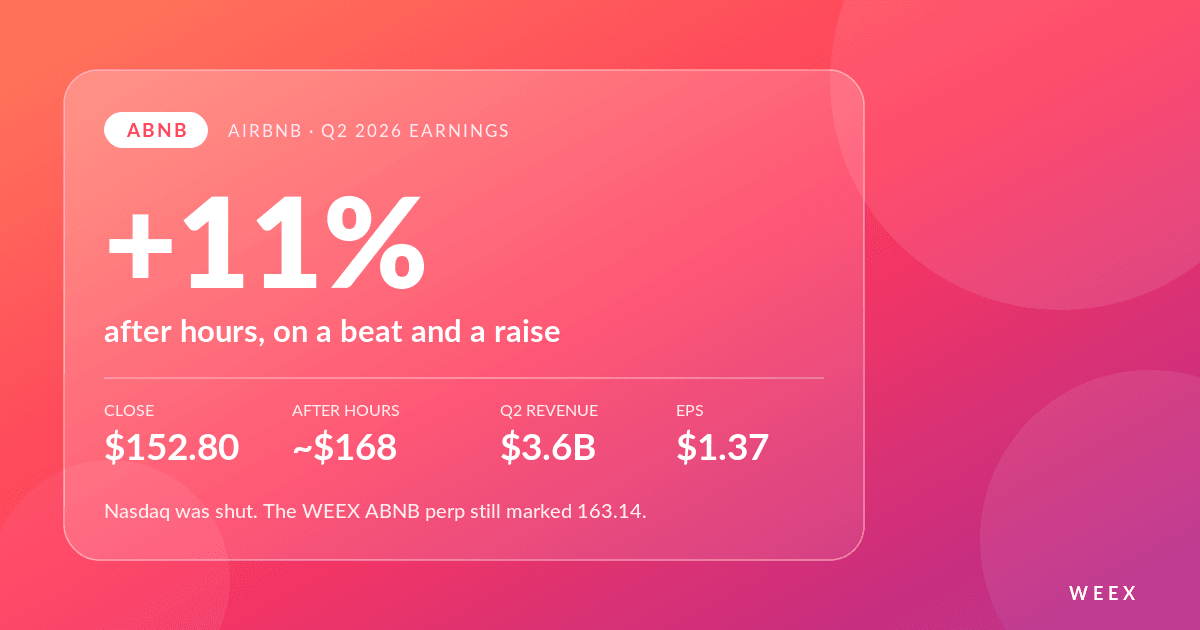
ABNB stock closed at $152.80 on Nasdaq on August 6, 2026, then jumped roughly 11% in after-hours trade to about $168 once Airbnb posted a Q2 that beat on every headline metric and raised full-year guidance for the second time this year. By early on August 7 the ABNB perpetual on WEEX was marking 163.14 — a live price for a stock whose home exchange was shut.
That gap between "the tape is closed" and "the price has already moved" is the practical story for anyone trying to act on Airbnb stock right now. Below: what Q2 actually contained, why the guidance raise matters more than the EPS beat, where the analyst targets now sit relative to the price, and the concrete ways to hold or hedge ABNB exposure outside US market hours.
ABNB stock price today and what Q2 changed
Airbnb reported after the close on August 6, 2026. The numbers ended a run of three consecutive EPS misses that had kept the stock rangebound between roughly $111 and $156 over the prior twelve months.
| Q2 2026 metric | Result | Change YoY | Versus expectations |
|---|---|---|---|
| Revenue | $3.6B | +17% | Above the $3.54–3.60B guide; consensus ~$3.58B |
| Gross booking value | $27.2B | +16% | Driven by demand plus higher ADR |
| Nights and Seats Booked | +10% | Accelerated from Q1 | Broad-based, including core markets |
| Net income | $816M | +27% | — |
| Diluted EPS | $1.37 | +33% | Beat consensus of about $1.25 |
| Adjusted EBITDA | $1.3B | +21% | Margin expanded to 35% |
Source: Airbnb Q2 2026 results, published August 6, 2026.
The line that moved the stock was not EPS. It was the acceleration in nights booked in the US, France, the UK and Australia — Airbnb's largest, most mature markets. Growth reaccelerating in a core market is much harder to fake with mix or FX than a revenue beat is, and it undercuts the bear case that Airbnb's home business had matured into a low-single-digit grower propped up by expansion markets.
Why Airbnb stock is going up: the guidance raise, not the beat
A beat is one quarter. A guidance raise is management putting its own credibility behind the next two.
Airbnb now guides Q3 2026 revenue to $4.69–4.77 billion, or 15–17% growth, and lifted full-year adjusted EBITDA margin to at least 35.5% from 35%. Full-year revenue growth was moved to "at least mid teens."
Two caveats worth holding onto. First, roughly three percentage points of that Q3 growth is an FX tailwind after hedging — so the underlying constant-currency number is closer to 12–14%. Second, management explicitly flagged that Q3 adjusted EBITDA margin will be down slightly year over year on investment timing. The full-year margin raise is back-half-weighted and depends on Q4 delivering.
The efficiency story is real, though, and it is where the AI narrative touches the P&L rather than the press release: customer-support cost per booking fell about 16% year over year, with nearly 45% of AI-assistant issues resolved without a human agent. That is a structural margin lever, not a one-quarter cost cut.
Is ABNB stock a good buy above $160?
Here is the awkward arithmetic. Before earnings, the consensus 12-month target sat in the $156–161 range across the major aggregators, with a spread from about $115 to $181. The after-hours print of roughly $168 puts ABNB above most of those targets on day one.
That does not make the stock a sell. It means the sell side has to revise upward before the "upside to target" framing works again, and revisions typically land over the following one to two weeks. Anyone using a price-target screen to make a decision this week is reading a number that predates the quarter it is supposed to reflect.
On valuation, ABNB traded at roughly 37× trailing earnings before the move. At about $168 against a 2026 EPS consensus near $5.19, the forward multiple sits in the low 30s — not cheap for a mid-teens grower, but defensible if the 35.5% margin holds and services, experiences and hotels keep compounding off a small base. Hotel nights grew roughly three times as fast as the homes business in Q2, though hotels are still a single-digit share of nights.
The better question than "is ABNB a good buy" is which claim you are actually underwriting: that travel demand stays firm through a US consumer slowdown, or that Airbnb's product velocity takes share regardless. Those need different position sizes.
How to trade ABNB stock when the Nasdaq is closed
This is where the earnings gap becomes a practical problem. Nasdaq's regular session runs 9:30–16:00 ET, with limited extended hours and thin liquidity. Airbnb reported at 16:08 ET. If you are outside the US, or you simply were not at a terminal, the entire repricing happened while your broker was shut.
Crypto venues have filled that window with USDT-margined exposure to equity prices. WEEX lists an ABNB/USDT perpetual that tracks the Airbnb share price with up to 20× leverage and settles in USDT, with no brokerage account or bank wire in the loop. It is part of WEEX TradFi, which extends the same USDT-margin model to gold, silver, crude oil and global indices.
| Route to ABNB exposure | Trading window | Margin/funding | What you actually own |
|---|---|---|---|
| Cash equity via broker | Nasdaq hours plus limited extended | Cash or margin account, bank funding | Real shares, voting and dividend rights |
| Tokenized ABNB stock token | Roughly 24/5, venue-dependent | Crypto wallet or exchange balance | A claim on a custodied share; economic exposure, usually no vote |
| ABNB/USDT perpetual (WEEX) | 24/7 | USDT margin, up to 20× | No share ownership — a derivative on the price, plus funding cost |
The distinction in the right-hand column is the one traders skip and later regret. A perpetual gives you price exposure and nothing else: no dividend, no vote, no cap-table claim. It also carries a funding rate that you pay or receive every few hours depending on which side is crowded — which, after a one-way earnings move, is usually the side you are on. Holding an equity perp for weeks to express a fundamental view is an expensive way to be right.
If you want the mechanics of how the custodied, 1:1-backed version differs from the derivative version, WEEX's explainer on tokenized US stocks covers the issuance and custody models in detail.
What ABNB bulls are underweighting
Three things are missing from most of the post-earnings commentary.
Weekend liquidity is not the same as weekday liquidity. A 24/7 equity perp is genuinely open on Saturday, but market makers cannot hedge into a closed cash market, so spreads widen and a modest order moves the mark. The gap-risk that matters is Sunday night into Monday open, when the perp has to reconcile with whatever the cash market decides.
Regulatory drag on short-term rentals has not gone away. It has simply stopped generating headlines. City-level caps and registration regimes compress supply in exactly the high-ADR urban markets that carry the take rate.
And the FX tailwind cuts both ways. Three points of Q3 growth from currency becomes a three-point headwind if the dollar strengthens, and that shows up in reported revenue without anything changing in the business.
The bottom line on ABNB stock
Q2 2026 was the quarter that broke Airbnb's miss streak, and the acceleration in core markets is the durable part of it. The reflexive risk is that the stock now trades above where most analysts said it should be twelve months from now, so the next few weeks are a race between target revisions and profit-taking.
For traders who want to act on ABNB stock outside Nasdaq hours — around earnings, guidance updates, or macro prints — USDT-margined exposure on WEEX removes the brokerage and settlement friction, at the cost of funding and the absence of any real ownership. Size it as a trade, not as a shareholding.
FAQ
1. Why did ABNB stock jump after Q2 2026 earnings?
Airbnb beat on revenue ($3.6B, +17%) and EPS ($1.37 versus roughly $1.25 expected), and raised full-year guidance for the second time in 2026. The stock added about 11% in after-hours trade on August 6, 2026. The acceleration in nights booked in the US, UK, France and Australia mattered more to the move than the EPS beat itself.
2. What is the ABNB stock price target for the next 12 months?
Pre-earnings consensus sat around $156–161, with a range from roughly $115 to $181 across 40–50 covering analysts. Those targets were set before the Q2 print and the guidance raise, so expect upward revisions. Treat any target published before August 6, 2026 as stale.
3. Can you trade ABNB stock 24/7?
Not as cash equity — Nasdaq is closed overnight, on weekends and on holidays. USDT-margined perpetual futures on the ABNB price, such as the ABNB/USDT contract on WEEX, trade continuously, but they are derivatives and confer no share ownership.
4. What is the difference between a tokenized ABNB stock and an ABNB perpetual?
A tokenized stock is issued against a real share held by a custodian and typically passes through economic rights such as dividends. A perpetual futures contract is a derivative on the price with a funding rate and no underlying claim. The tokenized version tracks ownership; the perpetual tracks price.
5. What is the biggest risk to Airbnb's raised 2026 guidance?
Two candidates. About three percentage points of the Q3 revenue growth guide comes from an FX tailwind that could reverse, and management has already signalled Q3 adjusted EBITDA margin will be down slightly year over year, which makes the full-year 35.5% margin target dependent on Q4 execution.
Risk Warning
Trading equity-linked derivatives and tokenized stocks carries substantial risk of partial or total loss. Leverage magnifies both gains and losses — a 20× position on ABNB can be liquidated by a move of roughly 5% against you, and earnings gaps of that size are common. Perpetual futures charge or pay funding continuously, so holding a directional view for weeks erodes returns even when the price cooperates. Liquidity on equity-linked contracts is thinner when the underlying cash market is closed, which widens spreads and increases slippage on weekends and holidays. Tokenized stocks carry issuer, custody and smart-contract risk, and holders generally receive economic exposure rather than legal share ownership or voting rights. Availability is restricted in several jurisdictions, including the US. Prices, guidance figures and analyst targets cited here reflect data as of August 7, 2026 and change without notice. None of this is investment advice.
This content is provided for general informational purposes only and doesn't constitute financial, investment, legal, or tax advice. Any events, rewards, online promotions, or related information mentioned herein should not be considered a recommendation, solicitation, or invitation to purchase, sell, trade, or otherwise deal in any crypto assets. Crypto assets are highly volatile and may result in loss. The availability of WEEX services, products, and related events may vary by region. You are responsible for ensuring that your participation is in accordance with applicable local laws and regulations.
You may also like

KGHM Stock Forum: Copper, Silver, and the Argument the Thread Keeps Getting Backwards

Gold Forum: Where the Polish Discussion Actually Happens — and the Question It Argues About Most

JSW Stock Forum: What the Threads Are Actually Arguing About — and What They Cannot Tell You

What Is Polymarket and How Does It Work?

What Is Phantom Wallet? How to Install the Official Version Safely and Use It

What Is the Crypto Fear and Greed Index? Components, Scale and Limits
What Is Robinhood Chain? How to Add the Network to MetaMask Safely
Is Zero Knowledge Technology Actually Ready for Everyday Use?
zk-SNARK vs zk-STARK: What's the Difference?

How Zero Knowledge Proofs Are Used in Blockchain Today
What Is Zero Knowledge Proof? A Beginner's Guide
Is PGP Still Secure in 2026?

PGP vs End-to-End Encryption: What's the Difference?
Roblox Stock Price Prediction 2026-2027: Can RBLX Recover After Pulling Full-Year Guidance?
Is RBLX Stock a Buy After Falling 74% From Its All-Time High?
Roblox Stock Falls 29% on Its Worst Day Ever: What the Bookings Miss and Pulled Guidance Actually Mean
Marvell Stock Jumps 13% on AI Memory Infrastructure Upgrades: What the New Portfolio Actually Changes

Opendoor Stock Price Prediction 2026-2027: Can OPEN Reach the $4.95 Analyst Target After the Q2 Turnaround?

Opendoor Stock Q2 2026: What Everything Is Up and Costs Are Down Actually Means for OPEN
Apple Stock and the China $280 Downgrade: What a Chinese Firm Cutting Apple to Hold Actually Signals
STONKBROKER Token: What You Actually Own Without a StonkBrokers NFT
Apple Stock Is Adding Android Phones to Trade-In: What the Strategy Shift Actually Means for iPhone Growth
Apple Stock and the OpenAI Lawsuit: What OpenAI Calling Apple's Case Careless and Aggressive Actually Means for AAPL
XST Coin and the Solana AI Narrative: Why Low-Cap AI Tokens Are Outperforming in August 2026
Should You Buy XST Coin at $0.020? What Changed Since the $0.007 Entry
XST Coin Is Up 188% in One Week: What Is Actually Driving the XSolut Rally
MU Stock at $892: Why Micron Fell 29% From Its Peak
SanDisk Earnings: Why $93.9B in Contracts Capped the Guide
SPCX Slips Below Its IPO Price as 911M Shares Unlock
Meta Stock Near $590: What the Cash Flow Collapse Means
KGHM Stock Forum: Copper, Silver, and the Argument the Thread Keeps Getting Backwards
Gold Forum: Where the Polish Discussion Actually Happens — and the Question It Argues About Most
JSW Stock Forum: What the Threads Are Actually Arguing About — and What They Cannot Tell You
What Is Polymarket and How Does It Work?
What Is Phantom Wallet? How to Install the Official Version Safely and Use It
What Is the Crypto Fear and Greed Index? Components, Scale and Limits
Contents
Popular coins
Latest articles



