
MU Stock at $892: Why Micron Fell 29% From Its Peak

 Prefer us on Google




MU stock closed at $892.67 on August 4, 2026 — about 29% below its 52-week high of $1,255, and 26% below the $1,213.37 record close it printed on June 25, the day after Micron reported the best quarter in its 48-year history. Both of those facts are true at the same time, and that is the whole story for anyone trading MU stock right now.
The quote pages will give you the number. What they will not tell you is why a company guiding to $50 billion of quarterly revenue trades at single-digit forward earnings, what the bears are actually worried about, and how a crypto-funded trader can take a position on either side of that argument without a brokerage account.
MU stock price today and the distance from the June peak
Here is the position as of the last close before this piece was written.
| Metric | Value | As of |
|---|---|---|
| Last close | $892.67 | Aug 4, 2026 |
| Prior close | $829.50 | Aug 3, 2026 |
| One-day move | +7.62% | Aug 4, 2026 |
| Record close | $1,213.37 | Jun 25, 2026 |
| 52-week high / low | $1,255.00 / $106.75 | Trailing 12M |
| Drawdown from record close | −26.4% | Aug 4, 2026 |
| Drawdown from 52-week high | −28.9% | Aug 4, 2026 |
| Year-to-date | +190.6% | Aug 4, 2026 |
| Trailing 12 months | +690.9% | Aug 4, 2026 |
| Market capitalisation | ≈ $1.01 trillion | Aug 2026 |
Read those last two rows before you read anything else. A stock that is up 690% over twelve months and still up 190% year-to-date has not broken. It has given back a slice of a violent advance. The 52-week low of $106.75 is the more revealing number — it tells you how far the memory cycle has travelled in a year, and how much profit was sitting in the position waiting for an excuse to leave.
Why MU stock fell while Micron's earnings hit records
The pullback did not start with a bad print. It started with a very good one.
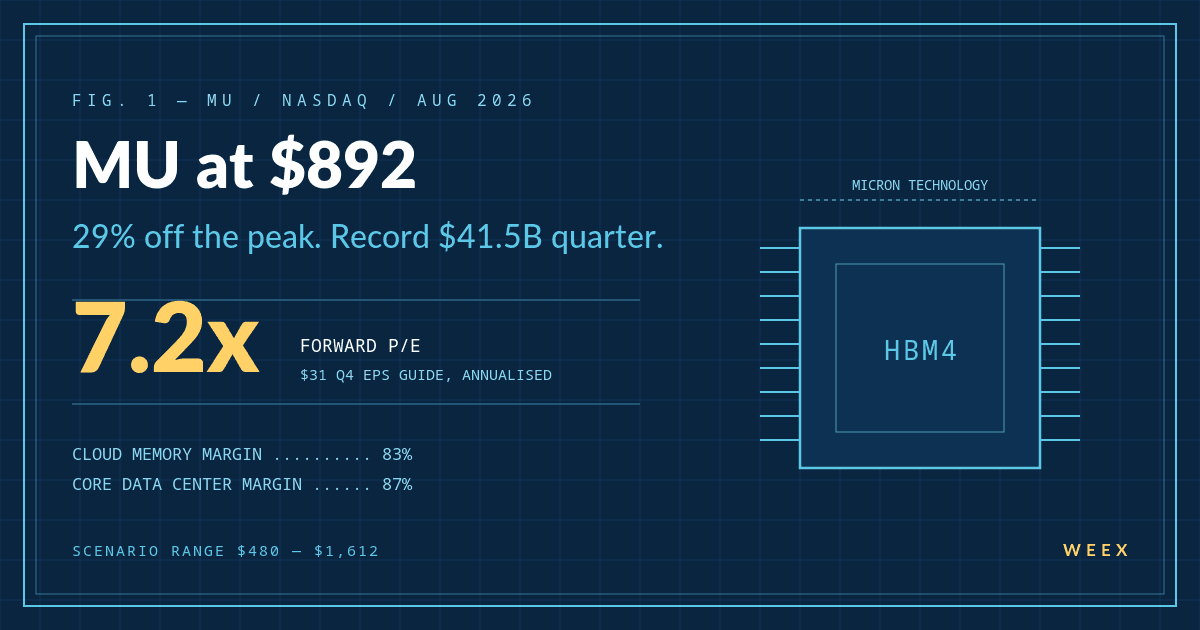
On June 24, 2026, Micron reported fiscal Q3 revenue of $41.46 billion, up 346% year over year and 74% sequentially, with non-GAAP gross margin of 84.9% and earnings of $25.11 per share against a $20.28 consensus. Shares jumped roughly 15% the next session to that $1,213 record. The selling came afterward, and it came from four places:
- Memory pricing fears. Records this good invite the obvious question — how much of this is price and how much is volume? DRAM and HBM pricing at these margins is an invitation for every competitor to add capacity.
- Supply expansion risk. Samsung and SK Hynix do not need to beat Micron on technology to compress its margins. They only need to ship.
- China and the custom-silicon threat. Reports that DeepSeek is developing its own AI accelerator to reduce dependence on Nvidia and Huawei fed a broader worry that hyperscaler demand may route around the current supply chain.
- AI capex durability. Early August saw a coordinated de-rating across semiconductors — Western Digital, Applied Materials, Marvell, AMD and Nvidia all slid together. MU stock was not singled out; it was the highest-beta way to express the same doubt.
The better reading is that this was a positioning event, not a fundamental one. Nothing in the four bullets above showed up in Micron's reported numbers. They are all forecasts about 2027.
What Micron's Q3 numbers say about the memory cycle
The segment detail matters more than the headline, because it shows where the margin is actually coming from.
| Business unit | Q3 FY26 revenue | Gross margin |
|---|---|---|
| Cloud Memory | $13.8B | 83% |
| Core Data Center | $11.5B | 87% |
| Mobile and Client | $11.5B | 87% |
| Automotive and Embedded | $4.6B | 79% |
Data centre revenue cleared $25 billion in the quarter — an annualised run rate above $100 billion — and now represents more than half of total sales. Micron guided fiscal Q4 to $50 billion ± $1 billion at roughly 86% gross margin and $31 ± $1 in EPS.
The number that should carry the most weight, though, is not on the income statement. Micron disclosed approximately $100 billion in remaining performance obligations across 16 strategic customer agreements, and management stated that the entire calendar 2026 HBM supply — including HBM4 — is sold out with price and volume already locked. That is contracted revenue, not a demand forecast. It is the single strongest argument against the "pricing is about to roll over" thesis, and it is why the drawdown looks more like multiple compression than earnings risk.
Is MU stock cheap at these levels, or a value trap?
Run the arithmetic yourself rather than taking a price target on faith.
Micron guides fiscal Q4 to $31 in EPS. Annualise that quarterly run rate and you get roughly $124 of earnings power. At the $892.67 close, MU stock is trading near 7.2x that annualised run rate. For comparison, the S&P 500 has spent most of the past decade north of 18x.
| Scenario | Assumed annualised EPS | Multiple | Implied MU price |
|---|---|---|---|
| Cycle rolls over hard | $60 | 8x | $480 |
| Margins compress, volumes hold | $90 | 9x | $810 |
| Current run rate persists | $124 | 10x | $1,240 |
| Run rate holds, multiple re-rates | $124 | 13x | $1,612 |
That table is the entire debate compressed into four rows. Note what it implies: at $892, the market is not pricing a mild slowdown. It is pricing something between "margins compress meaningfully" and "the run rate is not real." Whether that is cheap depends entirely on a judgment about the durability of AI memory demand into fiscal 2027 — and no valuation model resolves that for you.
This is also the classic trap in semiconductor investing. Memory stocks look cheapest at the top of the cycle, because trailing earnings are peak earnings and the multiple collapses to reflect what comes next. A 7x multiple on MU stock is either an obvious opportunity or a textbook cycle-peak signal, and honest analysis has to hold both possibilities open.
MU stock price targets: what the sell side is modelling
As of August 3, 2026, 29 analysts covering MU stock carried a Buy consensus with an average price target of $1,269.62 — about 42% above the August 4 close. The dispersion is wide, which is itself informative.
| Firm / analyst | Price target | Rating |
|---|---|---|
| Consensus (29 analysts) | $1,269.62 | Buy |
| Arete | $1,500 | Buy |
| Itaú BBA | $1,697.09 | Outperform |
| Atif Malik (long-term view) | $1,400 | Bullish |
Treat these as inputs, not conclusions. Sell-side targets on a cyclical at the top of its cycle are typically an extrapolation of the current run rate against a normalised multiple — which is the same calculation in the table above, with the analyst's assumptions substituted for yours. The useful signal is not the average; it is that even the low end of the published range sits materially above spot, meaning the sell side has not yet marked down its 2027 memory pricing assumptions.
How to trade MU stock 24/7 with USDT on WEEX
Micron has never issued a token, and there is no "MU coin." What exists on crypto venues is USDT-settled exposure that tracks the equity's price — useful when the debate above is moving faster than Nasdaq trading hours allow you to respond.
WEEX lists MU/USDT perpetual futures under its TradFi product line, settled in USDT with long and short direction and leverage up to 100x on tokenized stock pairs. The mechanics, in order:
- Deposit USDT to your WEEX account — no brokerage account or bank wire is involved, and there is no separate TradFi sub-account to fund.
- Open the TradFi market list and select MUUSDT.
- Choose direction. This is the part that matters given the current setup: a perp lets you express the bear case on memory pricing as directly as the bull case on HBM4.
- Size the position and set leverage conservatively. MU stock moved 7.62% in a single session on August 4. At 10x, that is a 76% swing on margin.
- Set stop-loss and take-profit before you place the order, not after.
Two structural details are easy to miss. First, you are trading price exposure — there is no share, no dividend, no vote. Second, liquidity is not uniform across the clock. Spreads on a US equity perp are tightest during New York hours and widen overnight and across weekends, when the underlying market is shut and market makers cannot hedge cleanly. If you need to be filled at a specific level, the off-hours book is where that assumption breaks.
If the instrument itself is unfamiliar, the mechanics of 1:1 backing, custody and the different issuance models are covered in the WEEX explainer on tokenized US stocks, and the specific question of what MUUSDT represents is answered in Does MU Have a Token?. Beyond MU, WEEX TradFi covers gold, silver, oil, indices and forex from the same USDT balance.
What MU traders usually get wrong
Three failure modes recur, and they are worth naming concretely.
Trading the earnings print instead of the guide. MU stock rose on the June 24 report and then fell for six weeks. The reaction to a memory earnings release is almost never about the quarter reported — it is about what the guide implies for pricing two quarters out. Traders who bought the beat and held into August learned this expensively.
Carrying leveraged perps through the gap. The underlying equity does not trade overnight, but the perp does. When Nasdaq reopens after a weekend of headlines, the mark can move through your stop rather than to it. Position size, not stop placement, is what protects you there.
Confusing a memory cycle with a secular trend. Micron's contracted 2026 supply is real and it is signed. What happens in fiscal 2027 depends on how much capacity the industry adds in response to 85% gross margins — and capacity decisions made today land eighteen months from now. Everyone who has traded DRAM through a full cycle knows how that sentence usually ends.
The bottom line on MU stock
MU stock sits in an unusual gap: record contracted revenue, a fully sold-out 2026 HBM book, a $100 billion RPO backlog, and a share price roughly a quarter below where it was six weeks ago. The bulls read that as compression waiting to unwind. The bears read the same 7x multiple as the market telling you these earnings will not repeat.
Both readings are defensible, which is precisely why direction matters less than sizing here. If you want exposure to the argument in either direction, MU/USDT perpetuals on WEEX TradFi give you round-the-clock access with USDT collateral — but treat the leverage as the risk it is, not as the feature it is marketed as.
FAQ
1. Why is MU stock down if Micron just reported record earnings?
The decline is driven by expectations for fiscal 2027, not the reported quarter. Investors are pricing in memory price compression from competitor capacity expansion, questions about AI capex durability, and profit-taking after a 690% twelve-month run. Micron's actual Q3 FY26 results — $41.46 billion revenue, 84.9% gross margin — beat consensus comfortably.
2. Is MU stock a buy at $892?
That depends on whether Micron's current earnings run rate is sustainable, which nobody can verify yet. At the August 4 close, MU stock trades near 7.2x its annualised Q4 EPS guidance of $31 — cheap on trailing math, but memory stocks routinely look cheapest at cycle peaks. The $100 billion RPO backlog is the strongest evidence for durability; competitor capacity additions are the strongest evidence against. This is not investment advice.
3. Does Micron have an official crypto token?
No. Micron Technology has never issued a cryptocurrency or token in any public disclosure. MUUSDT on crypto exchanges refers to USDT-settled instruments that track MU's price — tokenized stocks or perpetual futures — which convey price exposure only, with no equity, dividends or voting rights.
4. Can I trade MU stock outside US market hours?
Yes, through USDT-settled perpetuals such as MU/USDT on WEEX, which trade continuously. Be aware that liquidity thins and spreads widen when the underlying Nasdaq listing is closed, because market makers cannot hedge into the cash market during those windows.
5. What is the Wall Street price target for MU stock?
As of August 3, 2026, the consensus target across 29 analysts was $1,269.62, with a Buy rating. Published targets above consensus include $1,400, $1,500 from Arete and $1,697.09 from Itaú BBA. These figures reflect analyst assumptions about 2027 memory pricing and can be revised quickly after any guidance change.
6. What would change the MU stock thesis?
Watch three things: DRAM and HBM contract pricing announcements, capacity expansion capex from Samsung and SK Hynix, and Micron's fiscal Q4 report against its $50 billion revenue guide. A guide-down on fiscal 2027 pricing would validate the bear case faster than any macro headline.
Risk Warning
MU stock and MU-linked derivatives are volatile instruments and may result in partial or total loss of capital. MU shares fell roughly 26% from their June 2026 record close within six weeks, and moved 7.62% in a single session on August 4, 2026.
Specific risks apply to USDT-settled MU products on crypto venues. Leverage magnifies losses and can trigger liquidation on moves that would be survivable in an unlevered equity position — at 10x, a single-session 7% adverse move erases most of your margin. Liquidity risk is concentrated in off-hours and weekend sessions, when the underlying Nasdaq listing is closed and spreads widen materially. Perpetual funding fees accrue against holders on the crowded side of the book and erode returns on multi-day positions. Tracking risk means the perpetual price may deviate from the reference equity price during stress. These instruments confer no shareholding, dividend entitlement or voting rights in Micron Technology.
Micron's business carries cycle risk that is specific to memory semiconductors: gross margins near 85% historically invite capacity expansion that compresses pricing with an 18-month lag. Availability of WEEX products varies by jurisdiction and is subject to local regulation. Never allocate capital you cannot afford to lose, and treat published price targets as assumptions rather than forecasts.
This content is provided for general informational purposes only and doesn't constitute financial, investment, legal, or tax advice. Any events, rewards, online promotions, or related information mentioned herein should not be considered a recommendation, solicitation, or invitation to purchase, sell, trade, or otherwise deal in any crypto assets. Crypto assets are highly volatile and may result in loss. The availability of WEEX services, products, and related events may vary by region. You are responsible for ensuring that your participation is in accordance with applicable local laws and regulations.
You may also like

KGHM Stock Forum: Copper, Silver, and the Argument the Thread Keeps Getting Backwards

Gold Forum: Where the Polish Discussion Actually Happens — and the Question It Argues About Most

JSW Stock Forum: What the Threads Are Actually Arguing About — and What They Cannot Tell You

What Is Polymarket and How Does It Work?

What Is Phantom Wallet? How to Install the Official Version Safely and Use It

What Is the Crypto Fear and Greed Index? Components, Scale and Limits
What Is Robinhood Chain? How to Add the Network to MetaMask Safely
Is Zero Knowledge Technology Actually Ready for Everyday Use?
zk-SNARK vs zk-STARK: What's the Difference?

How Zero Knowledge Proofs Are Used in Blockchain Today
What Is Zero Knowledge Proof? A Beginner's Guide
Is PGP Still Secure in 2026?

PGP vs End-to-End Encryption: What's the Difference?
Roblox Stock Price Prediction 2026-2027: Can RBLX Recover After Pulling Full-Year Guidance?
Is RBLX Stock a Buy After Falling 74% From Its All-Time High?
Roblox Stock Falls 29% on Its Worst Day Ever: What the Bookings Miss and Pulled Guidance Actually Mean
Marvell Stock Jumps 13% on AI Memory Infrastructure Upgrades: What the New Portfolio Actually Changes

Opendoor Stock Price Prediction 2026-2027: Can OPEN Reach the $4.95 Analyst Target After the Q2 Turnaround?

Opendoor Stock Q2 2026: What Everything Is Up and Costs Are Down Actually Means for OPEN
Apple Stock and the China $280 Downgrade: What a Chinese Firm Cutting Apple to Hold Actually Signals
STONKBROKER Token: What You Actually Own Without a StonkBrokers NFT
Apple Stock Is Adding Android Phones to Trade-In: What the Strategy Shift Actually Means for iPhone Growth
Apple Stock and the OpenAI Lawsuit: What OpenAI Calling Apple's Case Careless and Aggressive Actually Means for AAPL
XST Coin and the Solana AI Narrative: Why Low-Cap AI Tokens Are Outperforming in August 2026
Should You Buy XST Coin at $0.020? What Changed Since the $0.007 Entry
XST Coin Is Up 188% in One Week: What Is Actually Driving the XSolut Rally
SanDisk Earnings: Why $93.9B in Contracts Capped the Guide
ABNB Stock Jumps 11% on Q2 Beat: What the Earnings Gap Means for Traders
SPCX Slips Below Its IPO Price as 911M Shares Unlock
Meta Stock Near $590: What the Cash Flow Collapse Means
KGHM Stock Forum: Copper, Silver, and the Argument the Thread Keeps Getting Backwards
Gold Forum: Where the Polish Discussion Actually Happens — and the Question It Argues About Most
JSW Stock Forum: What the Threads Are Actually Arguing About — and What They Cannot Tell You
What Is Polymarket and How Does It Work?
What Is Phantom Wallet? How to Install the Official Version Safely and Use It
What Is the Crypto Fear and Greed Index? Components, Scale and Limits


