
SanDisk Earnings: Why $93.9B in Contracts Capped the Guide

 Prefer us on Google


SanDisk's fiscal Q4 2026 earnings were the best quarter in the company's history by every headline measure, and the stock lost about 12% across the two sessions around the print. That is not a contradiction. It is what happens when a company converts a spot-priced commodity business into a contracted one and the market is still modelling the spot price.
SanDisk (NASDAQ: SNDK) reported after the close on August 5, 2026: revenue of $8.97 billion, up 51% sequentially and 372% year over year; non-GAAP gross margin of 84.6%; non-GAAP EPS of $39.25 against a $34.59 consensus. Shares closed that session at $1,351.76 and traded near $1,255 after hours, down 7.07%, then closed August 6 at $1,258.58 — roughly 11.8% below the $1,427.62 close that preceded the release.
The widely repeated explanation is that the fiscal Q1 2027 revenue guide missed. Check the consensus figure being used and that story gets shakier. This piece covers what SanDisk actually reported, why data center revenue grew nearly 1,300%, what really disappointed in the outlook, and what the $93.9 billion contract book means for anyone trading SNDK — or its tokenized wrapper — into fiscal 2027.
SanDisk Q4 FY2026 Earnings: The Numbers That Landed
All figures below come from SanDisk's own results release and earnings presentation dated August 5, 2026.
| Metric (fiscal Q4 2026) | Result | Prior quarter | Year ago |
|---|---|---|---|
| Revenue | $8.97B | — (+51% q/q) | — (+372% y/y) |
| Non-GAAP gross margin | 84.6% | 78.4% | 26.4% |
| Non-GAAP operating margin | 79.2% | — | — |
| Non-GAAP operating income | $7.104B | — (+68% q/q) | — |
| GAAP net income | $6.90B | — | — |
| GAAP diluted EPS | $43.97 | — | — |
| Non-GAAP diluted EPS | $39.25 | $23.41 | — |
| Operating cash flow | $7.126B | — (+135% q/q) | — |
| Adjusted free cash flow | $5.035B (56% margin) | — | — |
The margin line is the one worth staring at. A NAND business printing 84.6% non-GAAP gross margin is not a memory company in any historically recognisable sense — a year earlier the same business ran 26.4%. Operating expenses of $484 million against $8.97 billion of revenue is the other side of that: SanDisk grew revenue nearly fivefold while opex rose 8% sequentially.
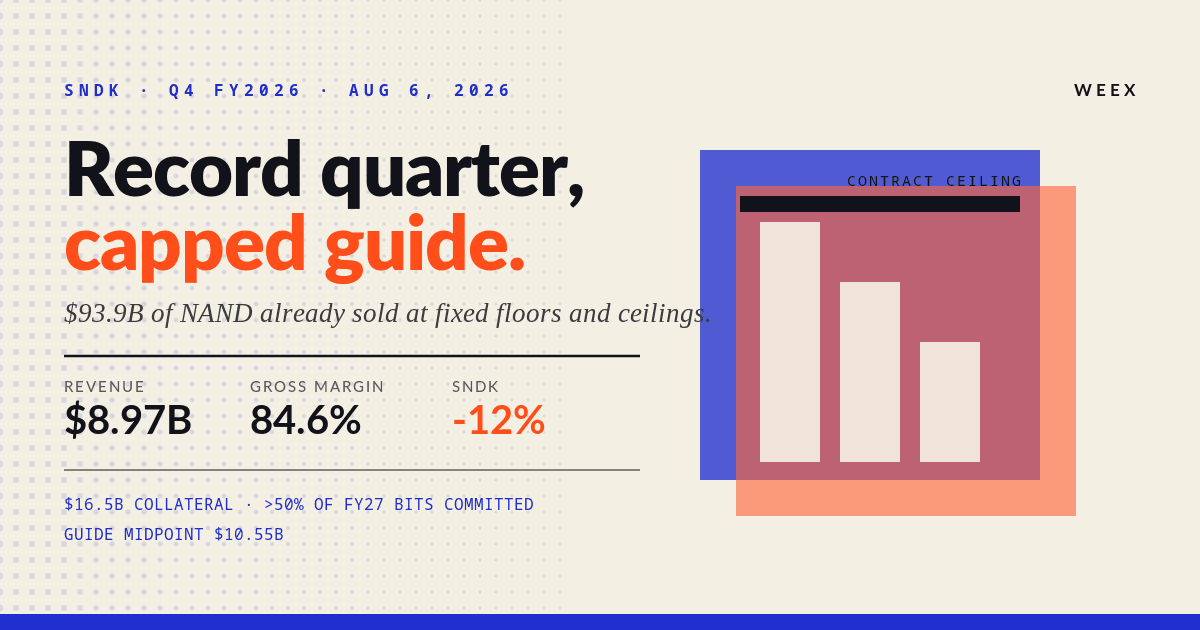
For the full fiscal year, revenue reached $20.25 billion, up 175%, with GAAP net income of $11.43 billion, GAAP diluted EPS of $73.76 and non-GAAP diluted EPS of $70.88. The company repurchased $4.5 billion of stock during the year and its board authorised a further $14 billion, taking total remaining buyback capacity to $15.5 billion.
One detail from the release explains most of the quarter: of the 51% sequential revenue increase, roughly one-third came from higher volumes and two-thirds from higher pricing. SanDisk did not ship dramatically more bits. It sold the bits it had into a market that had run out of supply.
Why SanDisk's Data Center Revenue Grew 1,298%
The segment split is where the transformation is legible.
| Segment (fiscal Q4 2026) | Revenue | Sequential | Year over year |
|---|---|---|---|
| Data Center | $2.977B | +103% | +1,298% |
| Edge | $5.432B | +48% | +392% |
| Consumer | $556M | −32% | — |
Data center share of total bits went from 12% in Q4 FY2025 to 38% in Q4 FY2026. Across the full fiscal year, data center revenue reached $5.153 billion, up 437%. Management's framing on the call was that AI inference is "a memory-centric, storage-intensive problem" — every model interaction generates content that has to be stored, retrieved and served at low latency, and that workload lands on high-capacity enterprise SSDs rather than on GPUs.
The consumer line moving the other way is not noise. SanDisk is deliberately reallocating scarce bits away from memory cards and retail SSDs toward hyperscale enterprise drives, where the pricing is better and the contracts are longer. A 32% sequential decline in consumer revenue during the tightest NAND market on record is a supply-allocation decision, not a demand failure.
Two technology markers set the fiscal 2027 backdrop. SanDisk is sampling BiCS10 1Tb TLC, which raises bit density about 59% over the BiCS8 generation now in mass production and pushes interface speed to 4.8Gb/s. And on August 3, 2026 — two days before earnings — SanDisk and SK hynix published the first open High Bandwidth Flash specification through the Open Compute Project, defining 8-high and 16-high NAND stacks up to 512GB with bandwidth grades running to 3.0TB/s. HBF is a late-decade revenue story, not a fiscal 2027 one, but it is the reason SanDisk is being valued as a technology franchise rather than a cyclical.
Why SNDK Stock Fell on Record Earnings
The headline explanation across the coverage on August 6 was a guidance miss. That framing depends entirely on which consensus number you pick up.
| Fiscal Q1 2027 outlook | Figure |
|---|---|
| Guided revenue | $10.3B–$10.8B (midpoint $10.55B) |
| LSEG average estimate | ~$10.47B |
| Other cited estimates | ~$10.62B to ~$11.16B |
| Guided non-GAAP gross margin | 83%–85% |
| Guided non-GAAP diluted EPS | $44.00–$46.00 |
| Assumed diluted shares | ~155M |
Against the LSEG average of roughly $10.47 billion, the $10.55 billion midpoint is a beat. Against the $11.16 billion figure circulating in some outlets, it is a 5% shortfall. The sell-off got attributed to a number that was not settled — and the midpoint still represents 18% sequential growth on top of a quarter that grew 51%.
What actually disappointed was narrower and more specific: the pricing embedded in the guide. Citi cut its price target from $2,500 to $2,100 and named "more muted" pricing as the reason. In a market where SanDisk itself projects NAND revenue above $300 billion in calendar 2026 and approaching $500 billion in calendar 2027, with bits on allocation past the end of 2027, investors expected the price line to keep compounding at the Q4 rate. It will not — and the reason sits in SanDisk's own contract structure, which is the part most of the coverage skipped.
The $93.9 Billion Contract Book Behind the Guide
SanDisk spent fiscal 2026 signing what it calls New Business Models: long-dated supply agreements with named customers, at pre-agreed price bands, backed by cash.
| New Business Model metrics (as of Aug 5, 2026) | Figure |
|---|---|
| Customers signed | 8 (data center and edge) |
| Minimum contracted revenue at floor pricing | $93.9B |
| Remaining performance obligation, quarter-end | $59.8B |
| RPO including post-quarter signings | $91.1B |
| Cash deposits and financial instruments | $16.5B |
| FY2027 bits committed | >50% |
| FY2028 bits committed | ~2/3 |
| Weighted average duration | >4 years |
Pricing under these deals blends fixed and variable components, with the variable portion bounded by floors and ceilings. CFO commentary on the call put the minimum expected revenue from signed NBMs at $93.9 billion assuming floor pricing, with actual revenue expected to come in above that.
That structure is the answer to the "muted pricing" complaint. If more than half of fiscal 2027 bits are already committed under contracts with price ceilings, spot NAND can keep ripping and SanDisk cannot fully monetise it. The Q1 outlook is not management signalling that demand is cracking. It is management telling you the contracts have taken the top off the distribution.
The trade-off runs both ways, and this is what the drawdown arguably mispriced. The same ceilings that cap the upside come attached to floors, $16.5 billion in deposits and instruments held mostly through third-party financial institutions, and quarter-by-quarter volume commitments stretching beyond four years. Memory equities have historically de-rated violently the moment pricing rolls over, because nothing sits underneath the revenue. SanDisk has spent a year building something that does. A business with $93.9 billion of floor-priced minimum revenue deserves a different multiple than a business selling into spot — and lower peak earnings power is the price of that.
The practical read: stop modelling SanDisk off DRAM-style spot pricing charts. Model it off contract coverage, and treat the uncommitted bit share as the variable line. The number to watch in November is not revenue — it is whether the 83–85% gross margin band holds as the committed share of bits rises from half to two-thirds.
Is the NAND Supercycle Peaking? What to Watch
The honest answer is that the pricing cycle probably peaks before the demand cycle does, and SanDisk's own guidance is the first evidence.
Concrete things that matter over the next two quarters:
- Gross margin band. 83–85% guided against 84.6% delivered. Flat-to-down margin on rising revenue means contracted pricing is diluting the spot mix. That is expected. A break below 83% is not.
- Sellable bits. Management's long-term supply objective is mid-to-high-teens bit growth, but for fiscal 2027 specifically the CFO guided sellable bit growth to the mid teens, because inventory has to be carried to service NBM commitments. Low bit growth in a shortage is a capacity statement, not a demand statement.
- Capital spending. Gross capex was $562 million in Q4, or 6.3% of revenue. Fiscal 2027 capex rises in absolute dollars to fund BiCS8 and BiCS10 while falling to roughly 6% of revenue. If capex jumps sharply across the industry instead, the 2028 supply picture changes and the whole thesis compresses.
- Consumer stabilisation. Consumer fell 32% sequentially. If it stays down while data center decelerates, the mix story stops working.
- Valuation. Analyst targets ran from $1,000 to $3,169 into the print, with consensus near a strong-buy. That dispersion is the market admitting it does not know how to value contracted memory earnings.
What experienced operators watch on a name like this is not the earnings beat but the second derivative of pricing. SNDK has already traded from a 52-week low of $40.53 to a high of $2,354.39. At those velocities, an ambiguous guide is enough to take 12% out of the stock in two sessions, and position sizing matters more than being right about the cycle.
How SNDKON Traded the SanDisk Earnings Drop
SanDisk's earnings landed after the NASDAQ close, which is exactly the window where the tokenized wrapper is useful — and exactly where its structural limits show.
SNDKON is the Ondo-issued token giving non-US traders economic exposure to SNDK, listed on WEEX as the SNDKON/USDT spot pair on April 6, 2026. Here is where it stood once the dust from the print settled:
| SNDKON on WEEX (as of Aug 7, 2026, 00:50 UTC) | Value |
|---|---|
| Price | $1,269.86 |
| 24h trading volume | $3.38M |
| Market cap | $6.89M |
| Total supply | 5,420 tokens |
| 7-day change | +22.28% |
| 30-day change | +50.06% |
| All-time high | $2,369.13 (Jun 25, 2026) |
| All-time low | $555.91 (Mar 30, 2026) |
Source: WEEX SanDisk Tokenized Stock (Ondo) price page.
Two observations that the equity tape cannot give you.
First, tracking held. SNDK closed August 6 at $1,258.58 and quoted near $1,270.18 in later dealing; SNDKON printed $1,269.86 at 00:50 UTC on August 7 — a premium of about 0.9% to the closing print, and near-parity against the later quote. Through an 11.8% two-session drawdown, a token with a 5,420-unit float stayed within a percentage point of the underlying once the US session was in the books. The mid-event dislocation was real, but it closed.
Second, the float is the risk. A $6.89 million market cap against $3.38 million of daily volume means the entire supply turns over in roughly two days. That is thin enough that a single sized market order moves the print, and it is why the wide intraday ranges around earnings are a liquidity artefact as much as a price discovery event. If you are trading tokenized equities through a catalyst, use limit orders, size for the book rather than for your conviction, and expect the widest spreads precisely when the news breaks. The general mechanics of how these instruments are issued, custodied and redeemed are covered in this explainer on tokenized US stocks.
What SanDisk Earnings Changed
The SanDisk earnings report closed the chapter where NAND was a cyclical commodity you traded off spot pricing charts. Revenue of $20.25 billion for the fiscal year, 84.6% gross margin in the fourth quarter, $5.15 billion of data center revenue and eight customers signed to $93.9 billion of floor-priced minimums describe a company that has been structurally repriced by AI inference demand.
The stock fell anyway, and not because the revenue guide clearly missed — its midpoint sat above the LSEG average. It fell because the pricing embedded in that guide told the market that the contracts cutting off the downside also cut off the top. That is the trade now: durability instead of torque. Whether it deserves a higher or lower multiple than the spot-priced version is the argument that will run through fiscal 2027 — and it is why the November gross margin print matters more than the revenue line.
Traders outside the US who want exposure across that window without a brokerage account can access SNDKON on WEEX with USDT, on a 24/5 basis that stays open when the NASDAQ does not. Check the live SNDKON/USDT market before sizing anything into the next earnings date.
FAQ
1. When did SanDisk report Q4 FY2026 earnings and what were the results?
SanDisk reported after the close on August 5, 2026. Revenue was $8.97 billion (up 51% sequentially, 372% year over year), non-GAAP gross margin was 84.6%, and non-GAAP diluted EPS was $39.25 against a $34.59 consensus. Full fiscal 2026 revenue was $20.25 billion.
2. Why did SNDK stock fall if SanDisk beat earnings?
Fiscal Q1 2027 revenue guidance of $10.3–$10.8 billion was read as light, though its $10.55 billion midpoint was above the LSEG average estimate of about $10.47 billion and below higher figures cited elsewhere. The clearer issue was pricing: Citi cut its target to $2,100 citing "more muted" pricing, which traces back to long-term supply contracts that cap how much of a spot NAND price rise SanDisk can capture.
3. How much of SanDisk's future revenue is already contracted?
SanDisk has signed eight data center and edge customers to New Business Model agreements representing a minimum of $93.9 billion in revenue at floor pricing, backed by $16.5 billion in cash deposits and financial instruments. More than half of fiscal 2027 bits and roughly two-thirds of fiscal 2028 bits are committed.
4. How big is SanDisk's data center business now?
Data center revenue was $2.977 billion in fiscal Q4 2026, up 103% sequentially and 1,298% year over year, and $5.153 billion for the full fiscal year, up 437%. Data center accounted for 38% of total bits shipped in the quarter, up from 12% a year earlier.
5. What is SNDKON and how does it relate to SanDisk stock?
SNDKON is an Ondo-issued token that provides economic exposure to SanDisk (SNDK) share performance, including reinvested dividends. It is not equity: holders get no voting rights or direct legal ownership of shares. It trades on WEEX against USDT and was listed on April 6, 2026.
6. Did SNDKON track SanDisk stock through the earnings drop?
Broadly, yes. SNDKON printed $1,269.86 at 00:50 UTC on August 7, 2026, against an SNDK August 6 close of $1,258.58 and a later quote near $1,270.18 — a premium of under 1% narrowing to near-parity. Intraday dislocations were wider while the US market was closed, which is typical for a token with a 5,420-unit float.
7. Is the NAND supercycle over after this guide?
The guide points to slower price escalation, not falling demand. SanDisk projects the NAND market above $300 billion in calendar 2026 — roughly triple the prior year — and approaching $500 billion in calendar 2027, and expects bits to remain on allocation beyond 2027. The near-term constraint is contract structure and capacity, not customer appetite.
Risk Warning
Crypto assets and tokenized equities are volatile and can result in partial or total loss of capital. SNDKON carries risks that SanDisk shares do not: a very small float (5,420 tokens, roughly $6.89 million in market value as of August 7, 2026) means thin order books and wide spreads, particularly around earnings and while US markets are closed. Holders take on issuer and custody risk with Ondo Finance, smart-contract risk on the underlying ERC-20, and the risk that the token's price detaches from the reference share price during periods of low liquidity. Tokenized stocks convey economic exposure only — no shareholder voting rights and no direct legal claim on the underlying shares — and are unavailable to US persons. Regulatory treatment of tokenized securities differs by jurisdiction and can change. SanDisk's own equity carries concentration risk in a single memory pricing cycle: the stock has traded between $40.53 and $2,354.39 over the past 52 weeks. None of the above is investment advice. Verify live prices before trading and size positions to what you can afford to lose.
This content is provided for general informational purposes only and doesn't constitute financial, investment, legal, or tax advice. Any events, rewards, online promotions, or related information mentioned herein should not be considered a recommendation, solicitation, or invitation to purchase, sell, trade, or otherwise deal in any crypto assets. Crypto assets are highly volatile and may result in loss. The availability of WEEX services, products, and related events may vary by region. You are responsible for ensuring that your participation is in accordance with applicable local laws and regulations.
You may also like
KGHM Stock Forum: Copper, Silver, and the Argument the Thread Keeps Getting Backwards
Gold Forum: Where the Polish Discussion Actually Happens — and the Question It Argues About Most
JSW Stock Forum: What the Threads Are Actually Arguing About — and What They Cannot Tell You

What Is Polymarket and How Does It Work?

What Is Phantom Wallet? How to Install the Official Version Safely and Use It

What Is the Crypto Fear and Greed Index? Components, Scale and Limits
What Is Robinhood Chain? How to Add the Network to MetaMask Safely
Is Zero Knowledge Technology Actually Ready for Everyday Use?
zk-SNARK vs zk-STARK: What's the Difference?
How Zero Knowledge Proofs Are Used in Blockchain Today
What Is Zero Knowledge Proof? A Beginner's Guide
Is PGP Still Secure in 2026?

PGP vs End-to-End Encryption: What's the Difference?
Roblox Stock Price Prediction 2026-2027: Can RBLX Recover After Pulling Full-Year Guidance?
Is RBLX Stock a Buy After Falling 74% From Its All-Time High?
Roblox Stock Falls 29% on Its Worst Day Ever: What the Bookings Miss and Pulled Guidance Actually Mean
Marvell Stock Jumps 13% on AI Memory Infrastructure Upgrades: What the New Portfolio Actually Changes

Opendoor Stock Price Prediction 2026-2027: Can OPEN Reach the $4.95 Analyst Target After the Q2 Turnaround?

Opendoor Stock Q2 2026: What Everything Is Up and Costs Are Down Actually Means for OPEN
Apple Stock and the China $280 Downgrade: What a Chinese Firm Cutting Apple to Hold Actually Signals
STONKBROKER Token: What You Actually Own Without a StonkBrokers NFT
Apple Stock Is Adding Android Phones to Trade-In: What the Strategy Shift Actually Means for iPhone Growth
Apple Stock and the OpenAI Lawsuit: What OpenAI Calling Apple's Case Careless and Aggressive Actually Means for AAPL
XST Coin and the Solana AI Narrative: Why Low-Cap AI Tokens Are Outperforming in August 2026
Should You Buy XST Coin at $0.020? What Changed Since the $0.007 Entry
XST Coin Is Up 188% in One Week: What Is Actually Driving the XSolut Rally
MU Stock at $892: Why Micron Fell 29% From Its Peak
ABNB Stock Jumps 11% on Q2 Beat: What the Earnings Gap Means for Traders
SPCX Slips Below Its IPO Price as 911M Shares Unlock
Meta Stock Near $590: What the Cash Flow Collapse Means
KGHM Stock Forum: Copper, Silver, and the Argument the Thread Keeps Getting Backwards
Gold Forum: Where the Polish Discussion Actually Happens — and the Question It Argues About Most
JSW Stock Forum: What the Threads Are Actually Arguing About — and What They Cannot Tell You
What Is Polymarket and How Does It Work?
What Is Phantom Wallet? How to Install the Official Version Safely and Use It
What Is the Crypto Fear and Greed Index? Components, Scale and Limits
Contents
Popular coins
Latest articles




